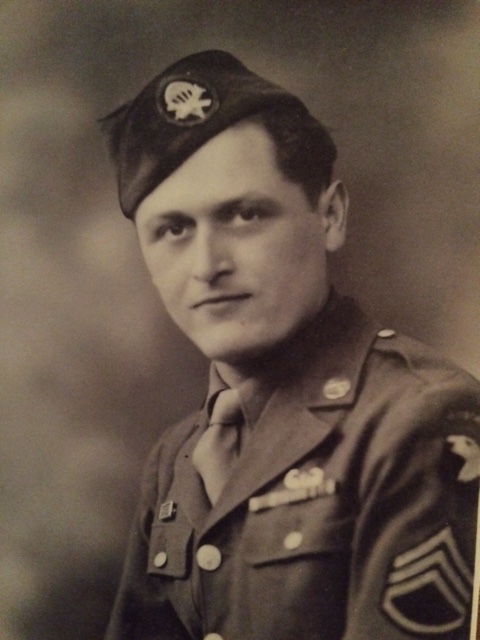
We are ready to embark on a journey to honor our father, Gustav Morlock, and retrace some of the footsteps that he took as he served in WWII with the 907th Glider Field Artillery Battalion of the 101st Airborne Division.
Gus Morlock 12/3/20 – 2/14/11
Amalia passed away when Gus was just eighteen years old, and his father never did spend much time at home after that. Gus was left to run the farm mostly by himself and quickly discovered that he did not like farming. That is likely why and how he ended up going to radio technology school on an island located in the harbor of Boston, MA in 1942. He did well in school until reaching the end of the course and learning that part of the final exam was serving a stint as an assistant radio operator on a cargo ship heading to England and back. This was during WWII and 1942 was the year of great success for the German U-boats sinking numerous cargo ships heading to England. Gus decided he did not want to complete the ship cruise and dropped out.
Gus decided to enlist in the Army and on New Year’s Eve 1942 found himself on a train headed to boot camp. He joined the 907th Glider Field Artillery Battalion of the 101st Airborne Division at Ft. Bragg, NC. At Ft. Bragg the Army learned of his radio training and assigned him a position as a radio operator/technician. The 907th had the word “Glider” in its name and they were trained to ride into battle in a WACO glider (also known as a flying coffin) being towed by a C-47 transport. Gus stated that he did not tell his dad about the glider portion of his job as it would just cause him to worry.
The 907th left Ft. Bragg, by train, on August 24th and arrived at Camp Shanks, NY the next day. On September 4, 1943 the 907th was aboard the S.S. Strathnaver, a British ship designed for warm weather cruises. Heading out the next day to England as part of a large convoy, things started to go wrong very quickly. The ship experienced engine trouble on September 9th and had to put into port at St. Johns, Nova Scotia. After a lengthy repair time, the S.S. Strathnaver was ready and departed on September 26th only to strike a rock leaving the harbor and punching a hole in the ship. After more days in port, the S.S. John Ericsson was diverted to pick up the 907th and transport them to England. It is worth noting that the entire voyage from New York to England took forty-four days, surpassing the voyage of Christopher Columbus when he discovered North America. Because of their time aboard ship at the North American continent, the unit was awarded the American Theater Service ribbon. The 907th felt they deserved the ribbon because they had kept the Germans from invading Canada.
After landing at Liverpool, England the 907th was based at Benham House, west of London. Continuous training, with a few breaks, took place in preparation for D-Day. One interesting item was that Gus learned a cousin who had grown up just a few miles from the family farm, was stationed at another base. On a weekend off, Gus traveled to visit his cousin. When he arrived there, he learned that his cousin had traveled to Benham House to pay him a surprise visit. They never did meet up in England.
On June 3, 1944 Gus and 183 other personnel loaded onto the USS Susan B. Anthony at Newbury, England and the ship moved into the bay. On June 5th they set sail for Utah Beach. They were approximately sixteen miles off Omaha Beach about 7 am on June7th when the Susan B. Anthony struck a floating mine. Gus was standing on the bow of the ship at the time and thought that maybe the ship had been hit by an artillery shell. He did not know about the mine until being told when he was 89 years old. All personnel were safely removed from the ship, transferred to other ships or landing craft, and shortly after 10 am the Susan B. Anthony sank. By 9 pm that evening all 907th personnel from the Susan B. Anthony were ashore, some on Omaha Beach and some on Utah Beach. Most of the unit’s guns and equipment were aboard a different ship that unloaded at Utah Beach later that day and they worked themselves off the shore and joined the battle. However, other members of the 907th who had been on two British MTB’s (Motor Torpedo Boats) did not land on Omaha Beach until June 9th, two days later.
The 907th was involved in the battle for the town of Carentan, which lasted a couple of days. Following that, they helped capture the town of Cherbourg from the Germans. Once in possession of Cherbourg the 907th was responsible for mopping up small groups of German troops in the area. By July 9th the 907th had been relieved of their responsibilities and on July 11th they boarded a ship for transport back to England.
In the coming days the 907th was scheduled for three different operations on the continent, but the allied forces were advancing so fast all three were called off. Finally, it was time for Operation Market Garden. This was a plan developed by British General Bernard Montgomery to capture a series of bridges (at Eindhoven, Arnhem, Grave, and Nijmegan) heading into Germany from Belgium and The Netherlands. The 907th was now going to implement the glider part of their name and enter the battle by flying to the target area and landing in WACO gliders towed by C-47s. On September 19th, 1944 Gus took off in a WACO glider headed for their assigned landing zone. While over the English Channel the mission was cancelled due to poor visibility and most of the 907th returned to England. Unfortunately some of the C-47 pilots did not receive the message and continued on the mission. The C-47 pilot released the glider containing Gus over a Belgian beet field close to the border with The Netherlands. Gus’ ability to speak German came in handy as he was able to speak with some of the locals to figure out where they were. By the next day Gus and a buddy arrived in Eerde and they had joined up with others from the 907th. The battle for The Netherlands lasted seventy-two days and the 907th was relieved on November 27th and directed to proceed to Mourmelone-le-Grand in France for R & R (rest and relaxation).
Members of the 907th were making plans for their Christmas, but the Germans had other ideas. On the morning of December 16th the Germans attacked in what became known as The Battle of the Bulge. On the evening of the 17th the unit received orders to be ready to move out at 1400 hours on the 18th. Gus rode in the back of a truck with much of the unit’s radio equipment. They were headed to Bastogne, Belgium which was a key transportation point because of the convergence of several roads. At Bastogne the Headquarters, A and B Batteries were spread out and assigned their locations. Shortly thereafter the German Army had the city of Bastogne surrounded. As the Germans continually attacked over the next week+, the radios of the 907th were being damaged and needed repair. As casualties mounted, Gus eventually became the primary repairman for the 907th radios. Soldiers would bring in units with bullet holes in them and Gus would repair them. He would also go out, moving from foxhole to foxhole, replacing radio batteries and repairing radios. At some point in the battle all the military medical staff in Bastogne had been killed. Several days later the weather cleared, and a WACO glider was able to land with medical supplies and a doctor. Gus watched the glider land on the street in Bastogne. He later met the pilot of that glider at a 101st Airborne Division reunion in the 1990’s. Gus was awarded a Bronze Star for his work in the Battle of the Bulge.
General George Patton’s unit broke through the German lines into Bastogne on December 26th. The 907th continued to support battle efforts around Bastogne until relieved of duty on January 20th of 1945. Although they were supposed to go on R & R for a period of time, the 907th was immediately committed to a new role. For the remainder of WWII the unit served in either a backup role or as an occupying force as the Allies advanced into Germany. The unit was stationed about 20 miles west of Munich, Germany when the war ended.
For his service Gus was awarded a Bronze Star, Presidential Unit Citation, Army Good Conduct Medal, American Campaign Medal, Europe-Africa-Middle East Campaign Medal, and a WWII Victory Medal by the U.S. Army. He also was awarded a French Croix de Guerre Medal for his part of the liberation of France.
The 907th served as an occupation force for several months before being brought home. Gus had written his Dad that he would be home by Thanksgiving. He crossed the Atlantic on a ship back to the United States in the fall, a voyage he described as a sick roller coaster due to rough seas. True to his word, TSgt. Gus Morlock walked through the door back in Pettibone, ND the day before Thanksgiving, 1945.

 In Our Father's Footsteps
I never knew any of this about Uncle Gus! What a great man he was! I’m proud he’s my uncle!
LikeLike
Thank-you Pam!
LikeLike
Thanks for your kind words Pam.
LikeLike